Why 8 Minutes Is Enough to Record Stories From Your Loved Ones
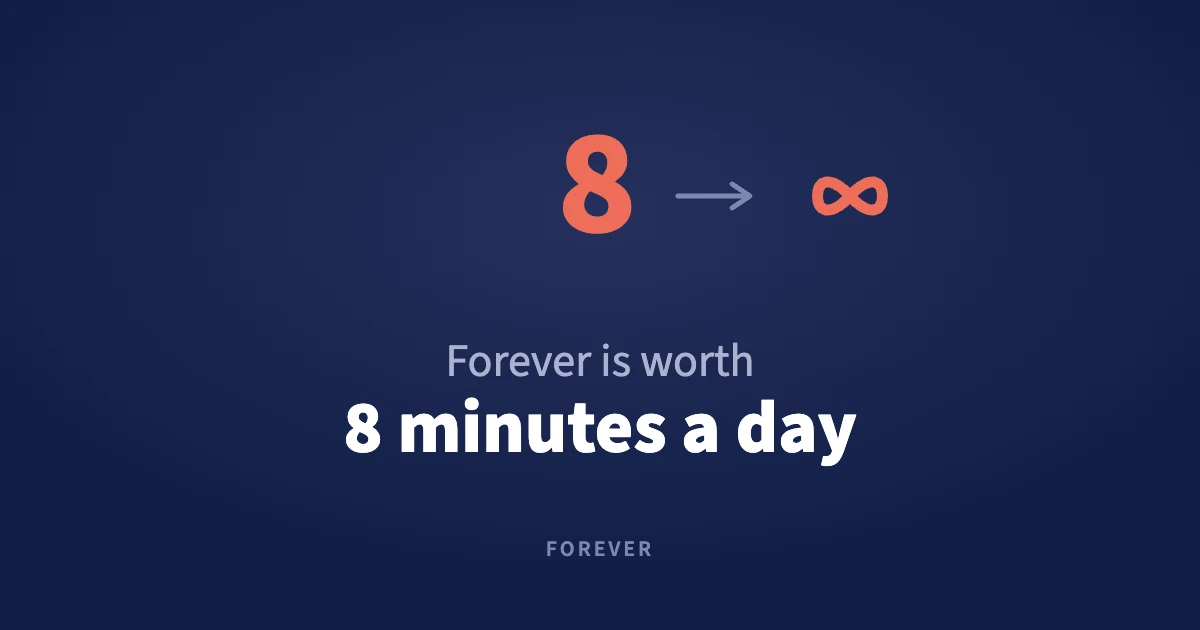
Eight minutes a day is the smallest habit I have found for recording your loved ones' stories before they are gone. It is short enough that you actually press record, long enough to land two or three real memories, and lucky enough to be a daily nudge in disguise. Here is how it started, with my father, who reads fortunes for a living.
My father reads fortunes for a living. Not as a hobby, not on weekends, not as a thing he picked up. He sits with people, takes their hands or looks at the year they were born, and tells them what he sees. He has been doing it longer than I have been alive.
A few years back I was building my first AI company and I needed a domain name. If you have ever tried, you know how it goes. Every good word in the dictionary is taken. After enough dead ends, I stopped searching for the perfect name and started thinking about what actually had meaning to me.
Why I picked the number eight
In much of Asia, eight is the lucky number. It is the one you want on your license plate, the one couples slip into a wedding date, the one that quietly shows up when someone hopes things will go well. For my father, eight is part of the air he breathes. So I picked it. A small homage, tucked into a URL where only I would really know what it was for.
Eight on its side: from lucky number to infinite memories
Then I noticed something I had walked past my whole life. Turn an eight on its side and it becomes the symbol for infinity. That turned out to be the whole idea. Infinite leverage. Infinite possibilities in the work you do. And here, with Forever, infinite memories with the people you love.
Not infinite in some abstract way. Infinite in the sense that I still get to hear my father's voice on a Tuesday. That I still get to ask him one more question, even one I have asked before. The conversations are beautiful and lucky and wonderful, and they last.
Why eight minutes is enough to record stories from your loved ones
Anyone who has read Atomic Habits already knows the punchline. The secret is not effort. The secret is starting. Most of us mean to record our loved ones' stories someday, but someday is harder to schedule than this Sunday. The number on the clock is the difference between a recording that exists and one that does not.
I tried longer sessions. They felt like work. Sixty minutes is a commitment, and people cancel commitments. Five minutes is too short to get past the throat-clearing. Eight is the only number that survives a Sunday.
Eight minutes is one good question, one real answer, one wandering aside that turns out to be the best part. It fits inside a Sunday phone call. It survives the I-don't-know-what-to-talk-about opening. It is short enough that the storyteller does not tire, and long enough that the story has somewhere to go.
And the recorder keeps listening past the eight-minute mark. Most of the best minutes are the bonus ones, the ones that come after the explicit prompt and before the polite goodbye. Most days I sit down for eight minutes with my father and end up still on the phone fifty minutes later. Sometimes eighty. Once, eighty-eight.
Eight minutes a day is roughly forty-eight hours of your loved one's voice over a year. Two full days of one person, in their own voice, telling you about a life you have only seen pieces of. Most families never accumulate that much. The ones that do tend to do it by accident, in the last week.
That is the whole secret. You do not need a perfect ritual to preserve family memories. You just need a number small enough that you start. If we are going to pick one, why not the lucky one. The one that, on its side, never ends.
Forever is the version of that accumulation that happens on purpose, on the first day, and every day after.
Below are a few questions I hear most often. If you are still on the fence about starting, maybe one of them is yours.
How long should it take to record a story with a loved one?
Eight minutes is the sweet spot. It is long enough for two or three real memories, and short enough that the recording actually happens. Most sessions naturally run longer once the conversation gets going, but eight is the number that gets you to press record in the first place.
What is the best way to preserve family memories?
Consistency beats production value every time. A daily eight-minute voice recording, in your loved one's own voice, is worth more in twenty years than a single polished interview. The goal is to capture the way he laughs, the way she thinks out loud, the small details no transcript can hold.
What questions should I ask my loved ones to record their stories?
Start small and specific. Not 'tell me about your childhood,' but 'what did you eat after school when you were nine?' The eight-minute window protects you from big-question paralysis. You only have room for the small ones, and the small ones are where the real stories live. Forever sends a fresh prompt every day so you do not have to think one up.
Can I really tell a meaningful story in eight minutes?
Yes, and most people are surprised by how quickly the door opens. One good prompt, one honest answer, one wandering aside, and you have something worth keeping. The point is not to finish a memoir. The point is to never run out of moments to ask about.
Why is the number eight considered lucky?
In Chinese culture and across much of Asia, eight is associated with prosperity, abundance, and good fortune. Its sound in Mandarin and Cantonese is close to the word for wealth. In Forever, eight does double duty: it is a quiet homage to my father, and the smallest habit big enough to change what your family remembers.